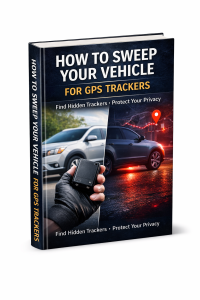
There are only ~100 professional bug sweep companies in the entire United States.
Most won’t travel. Most require a $3,500 minimum for a full property sweep. And almost none will do a vehicle-only check. You’ve probably figured that out by now.
But we can give you the next best thing: The exact methodology our technicians use to find trackers on vehicles, so you can check your vehicle yourself, today, without waiting or spending $750-$1,250.
You already suspect something is wrong. By the way, some GPS trackers come with audio and could be listening to every conversation you have in your vehicle!
Maybe your ex knows too much about your schedule. Maybe you’re going through a divorce, and things are getting ugly. Maybe someone always seems to show up where you are.
You don’t need us to tell you the fear is real.
What you need is a way to find out for sure — without:
This ebook gives you that option.
Michael Auletta is President of USA Bugsweeps Inc. and has conducted over 1,000 technical surveillance countermeasures (TSCM) sweeps nationwide in his 15+ year career.
This ebook contains the same systematic search methodology Michael’s technicians follow — minus the $150K in equipment.
You’re not getting generic internet advice. You’re getting field-tested tradecraft from someone who finds trackers for a living.
People who plant trackers rarely have much time. They’re rushing. They’re nervous.
That works in your favor.
After conducting hundreds of vehicle sweeps, we know exactly where trackers get placed most often, and this guide shows you those spots with photos, diagrams, and real examples from actual cases.
You’ll learn:
✓ The 5 most common hiding spots (where we find them again and again)
✓ What GPS trackers, magnetic trackers, and Bluetooth devices (AirTags, Tiles) actually look like
✓ How to tell the difference between a tracker and factory-installed vehicle components
✓ How to use free smartphone apps to detect AirTags and Tiles
✓ How to inspect your vehicle systematically without missing anything
✓ What to do if you find something — and what NOT to do
No special tools required. Just a flashlight, a blanket to lie on, and about 60-90 minutes.
If you find a tracker (which happens in about 50% of cases):
You’ll know you weren’t imagining things. You’ll have proof. You can decide your next move, whether that’s involving law enforcement, confronting someone, or quietly removing it.
If you don’t find anything (the other 50%):
You’ll have peace of mind knowing you checked thoroughly using professional methodology. You can stop the paranoid spiral and move forward.
Our professional sweeps use sophisticated RF detection equipment that can find trackers even when they’re powered off or hardwired deep inside a dashboard.
You don’t have that equipment.
But here’s what matters: Most people who plant trackers aren’t sophisticated operators. They’re using:
These account for roughly 80% of what we find in the field — and this guide shows you exactly how to find them.
The remaining 20%? Those are professionally installed, hardwired systems hidden behind dashboards that require our detection equipment to locate. If you’re dealing with that level of surveillance, you’ll know from the context of your situation — and you’ll know when it’s time to escalate.
But start here first. Because most of the time, it’s simpler than you think.
Here’s the timeline if you tried to hire a professional:
Here’s the timeline with this guide:
Total time from right now to having answers: 90 minutes.
No waiting. No scheduling. No explaining your situation to strangers.
Just you, your vehicle, and a systematic method that finds trackers on hundreds of cars nationwide.
This isn’t a generic “privacy tips” ebook. It’s a field manual based on real investigations.
We’ve found trackers on vehicles belonging to:
We share where we found them, what they looked like, and how they were hidden — without identifying anyone.
You’re learning from over 500 real vehicle sweeps, not speculation or internet rumors.
That’s our actual rate for clients in New Jersey and Florida.
For that price, you get:
It’s worth every penny for high-stakes situations.
But most people calling us don’t live in NJ, FL, or Southern California. And even if they did, $750+ isn’t always realistic, especially when you’re not even sure if there’s actually a tracker.
That’s exactly why this guide exists.
For $29, you get the same systematic methodology our technicians follow, you’re just doing the physical inspection yourself.
No shipping. No waiting. No account creation.
You’re literally 2 minutes away from having professional-grade guidance in your hands.
Every day a tracker stays on your vehicle is another day of surveillance.
Another day someone knows:
If you suspect tracking, the time to check is now, not next week when you finally find a professional who might be able to help.
This guide gives you the power to take action today.
If it’s a magnetic GPS tracker, an AirTag/Tile, or an OBD-II device (which accounts for 80% of what we find), yes. This guide shows you exactly where to look with photos and real examples. You’ll need a flashlight, a blanket to lie on, and about an hour. The other 20% are sophisticated hardwired systems that require our detection equipment, but those are rare and usually only used in high-stakes corporate or criminal situations.
You don’t need to be. You’re not taking anything apart or using tools. You’re visually inspecting specific areas of your vehicle using a systematic checklist. If you can use a flashlight and look under your car, you can do this. We walk you through every step with clear photos.
Free articles are written by bloggers guessing about where trackers might be. This guide is written by a TSCM professional who has personally conducted 500+ vehicle sweeps and actually found trackers in real investigations. You’re getting field-tested methodology, not speculation. Plus real photos of actual devices and hiding spots.
USA Bugsweeps is a professional TSCM and counter-surveillance firm that performs real-world GPS detection sweeps nationwide. The methods in this guide are based on proven professional inspection techniques used in actual investigations.
The guide covers evidence handling basics and your options. Some people immediately call law enforcement. Some remove the device themselves. Some leave it in place while they plan their next move. We explain the considerations for each approach so you can make an informed decision based on your specific situation.
Yes. Most GPS trackers have their own battery and don’t rely on your vehicle’s power. They can track and record your movements 24/7. Some are hardwired into your vehicle’s electrical system. The guide explains the different types and how each works.
Reading the relevant sections: 15-30 minutes. Performing the actual inspection: about 60 minutes if you’re thorough. Total time from purchase to completion: roughly 90 minutes. Compare that to waiting days or weeks for a professional appointment (if you can even find one in your area).
That’s exactly who this guide is for. There are only about 100 professional bug sweep companies in the entire United States. If you live in Montana, Wyoming, North Dakota, South Dakota, Arizona, or dozens of other states, your nearest TSCM professional might be several states away, if there’s anyone at all. This guide is your only realistic option besides doing nothing.
Yes. This isn’t a generic ebook padded with filler. It’s a field manual based on 1,000+ actual sweeps conducted nationwide. Michael Auletta is a DoD operative-trained Certified technician, a TSCM instructor, and has found trackers on vehicles for celebrities, politicians, and executives. You’re getting his methodology for $29 instead of paying $750+ for him to do it for you. The only difference is you’re doing the physical inspection yourself.
It means you’ve done a thorough inspection using professional methodology and didn’t find the most common types of tracking devices. That’s either because there’s nothing there (which happens in about 50% of cases), or because you’re dealing with a sophisticated hardwired system that requires electronic detection equipment. For most people, this guide gives you the certainty you need. If you’re in a high-risk situation and still have concerns, that’s when you’d escalate to a professional sweep with full equipment.
Choice 1: Do nothing.
Continue living with the fear and uncertainty. Keep wondering if someone knows where you are. Let the paranoia control your decisions.
Choice 2: Take action in the next 90 minutes.
Download this guide. Check your vehicle systematically using proven methodology. Get answers one way or the other. Move forward with certainty instead of fear.
The tracker (if there is one) isn’t going to remove itself.
The fear isn’t going to go away on its own.
But you can do something about it today.
Written by Michael Auletta, LPI, TSCM
President, USA Bugsweeps Inc.
DoD Operative-Trained, TSCM Certified • 15+ Years Experience • 1,000+ Sweeps Conducted Nationwide