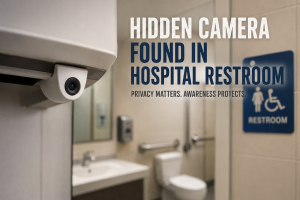
Hidden Camera Found in Hospital Staff Restroom: A Serious Reminder About Workplace Privacy
A recent hidden camera investigation at J.W. Ruby Memorial Hospital in Morgantown, West Virginia, is a serious reminder that workplace privacy concerns are not limited to offices, boardrooms, or executive suites.
According to news reports, a WVU Medicine employee was suspended after a hidden video recording device was found in a non-public staff restroom at J.W. Ruby Memorial Hospital on Friday, June 26, 2026. A facilities team member reportedly discovered the device, and hospital officials later said an internal review connected an employee to the incident. The matter was turned over to law enforcement.
Reports later stated that a second hidden recording device was found on Tuesday, June 30, 2026, in another non-public staff restroom, and that WVU Hospitals said the employee had been terminated as the investigation continued with law enforcement and the Monongalia County Prosecutor’s Office.
This type of incident is disturbing because restrooms, locker rooms, changing rooms, and other private spaces are areas where people have a strong expectation of privacy. When a recording device is discovered in one of these areas, the concern is not only about the device itself. The larger concern is whether the problem was isolated, whether other areas were affected, and how quickly the organization can respond.
What Happened at the Hospital?
Based on the reported information, the first device was discovered in a staff restroom at J.W. Ruby Memorial Hospital. Hospital officials reportedly conducted a short internal review and identified an employee connected to the incident. That employee was suspended, and the case was referred to law enforcement.
The hospital also reportedly inspected public and staff restrooms across several medical campus locations to determine whether other devices were present. Early reports said no additional cameras were found during that review.
However, updated reports later stated that a second recording device was found during a facilities response to a clogged toilet in a non-public staff restroom. That second discovery raised the seriousness of the matter and showed why a single discovery should never be treated casually.
At this stage, the investigation belongs to law enforcement and prosecutors. It is important not to assume facts that have not been publicly confirmed. But from a workplace privacy standpoint, this case highlights a major issue: organizations need a clear plan for responding when a hidden camera or recording device is found.
Why This Matters to Employers, Employees, and Customers
Most people think of hidden cameras as something that happens in hotel rooms, rentals, apartments, or private homes. But hidden camera concerns can also happen in workplaces.
Businesses, hospitals, schools, gyms, offices, retail locations, warehouses, restaurants, and corporate facilities all have areas where privacy must be protected. These may include:
Employee restrooms
Public restrooms
Locker rooms
Changing rooms
Nursing rooms
Medical exam rooms
Employee break areas
Executive offices
Conference rooms
HR meeting rooms
When a hidden recording device is found in a workplace, the organization may face several serious concerns. There may be employee trust issues, customer safety concerns, possible legal exposure, media attention, internal disruption, and the need to preserve evidence properly.
That is why hidden camera detection should not be treated as a simple maintenance issue. It is a privacy, security, legal, and workplace safety concern.
“Anytime a hidden camera is found in a restroom, locker room, changing room, or private workplace area, the organization has to take the situation seriously. The first question is not only who placed it there, but whether there are any other devices, where they may be located, and how to protect employees, visitors, and evidence during the response.”
Jimmie Mesis LPI, BAI, TSCM
Businesses Need a Privacy Safety Plan Before Something Happens
A hidden camera incident can damage more than privacy. It can damage employee confidence, customer trust, and the reputation of the business.
That is why companies should not wait until a device is found before thinking about privacy protection. Businesses should have a basic privacy safety plan that explains how sensitive areas are monitored, inspected, reported, and protected.
USAB President Michael Auletta says business owners and managers should treat privacy protection as part of their normal safety responsibilities:
“Businesses have a responsibility to protect both customers and employees in private areas such as restrooms, locker rooms, fitting rooms, and changing areas. That means having written procedures, training staff on what to look for, limiting access to sensitive spaces, and bringing in professionals when there is a concern. A hidden camera incident is not just a security issue. It is a trust issue.”
Practical safety measures may include:
Regular inspections of restrooms, locker rooms, and changing areas
Clear reporting procedures for suspicious objects or privacy concerns
Employee training on how to report a possible hidden camera
Restricting access to maintenance rooms, ceiling panels, storage closets, and utility areas
Keeping records of who has access to sensitive areas
Keeping records of who has access to sensitive areas
Reviewing who has keys, access cards, or security codes
Documenting repairs, maintenance visits, and contractor activity
Using professional TSCM inspections when concerns arise
Creating a response plan for management, HR, legal counsel, and law enforcement
Why One Device May Not Be the Whole Story
Finding one hidden camera does not automatically mean there are more. But it also does not prove the problem is limited to one location.
That is why a professional workplace bug sweep or corporate TSCM inspection may be necessary after a device is found. A qualified inspection can help determine whether additional recording devices, listening devices, or suspicious electronics are present in sensitive areas.
In a workplace setting, the goal is not to create panic. The goal is to respond in a careful, professional, and documented way.
A proper response may include:
Securing the area where the device was found
Avoiding unnecessary handling of the device
Notifying appropriate internal leadership
Contacting law enforcement when appropriate
Preserving possible evidence
Identifying similar high-risk areas
Arranging a professional TSCM or hidden camera sweep
Documenting what areas were checked
Communicating responsibly with affected employees
Businesses should avoid making public claims before facts are confirmed. They should also avoid having untrained employees search sensitive areas in a way that could damage evidence or miss well-hidden devices.
Why Restrooms, Locker Rooms, and Changing Rooms Need Special Attention
Restrooms and changing areas are among the most sensitive spaces in any facility. These areas deserve special attention because they involve personal privacy and dignity.
A hidden camera in a conference room is serious. A hidden camera in a restroom or changing room is even more invasive.
Devices can be small, inexpensive, and disguised in ordinary objects. Some may look like chargers, hooks, smoke detectors, pens, clocks, air fresheners, vents, or other everyday items. In some cases, a device may be hidden in a wall, ceiling, plumbing area, fixture, or object already inside the room.
That does not mean every object is suspicious. It means the inspection should be performed carefully by someone who understands what to look for.
Professional hidden camera detection may involve a combination of visual inspection, radio frequency detection, lens detection, physical inspection, and other TSCM methods. No responsible company should promise that every device will always be found in every situation, but a professional inspection gives the client a far better chance than guessing or relying on a casual search.
Workplace and Corporate Bug Sweeps Are Not Just for Executive Offices
Many companies think of bug sweeps only when they are worried about trade secrets, board meetings, lawsuits, executive conversations, or confidential business information.
Those are valid reasons for a corporate bug sweep. But today, workplace privacy concerns go beyond boardrooms.
A workplace bug sweep may be needed when:
A hidden camera is found
Employees report privacy concerns
Customers report suspicious objects in private areas
There are sensitive HR or legal meetings
A company is involved in litigation
Executives or employees suspect surveillance
A restroom, locker room, or changing area may have been compromised
There has been a workplace dispute
A terminated employee had access to private areas
A contractor, vendor, or employee had unsupervised access to sensitive spaces
A business wants a preventive inspection of private or high-risk areas
For healthcare facilities, schools, gyms, hotels, corporate offices, retail fitting rooms, and other public-facing organizations, the privacy risk can be even greater because many people may have access to the property.
What Should a Business Do If a Hidden Camera Is Found?
If a business discovers a possible hidden camera or recording device, it should avoid panic and follow a careful process.
First, do not touch or move the device unless there is an immediate safety reason. The device may be evidence. Handling it unnecessarily could affect an investigation.
Second, secure the area. Keep people away from the location and limit access.
Third, notify the appropriate people inside the organization. This may include ownership, senior management, security, HR, legal counsel, compliance, or risk management.
Fourth, contact law enforcement when the situation involves a private area such as a restroom, locker room, changing room, medical room, or similar space.
Fifth, arrange for a professional hidden camera detection or workplace bug sweep to check the affected area and other similar spaces.
Finally, document what was found, who was notified, what actions were taken, and what areas were inspected.
How USA Bugsweeps, Inc. Helps With Workplace Privacy Concerns
USA Bugsweeps, Inc. provides professional bug sweep and TSCM services for people and organizations concerned about hidden cameras, listening devices, GPS trackers, and other privacy threats.
For workplace and corporate clients, USA Bugsweeps can help inspect sensitive business areas where privacy matters. This may include offices, conference rooms, restrooms, locker rooms, changing areas, executive spaces, and other locations where a client has concerns.
For bathroom, locker room, or changing room hidden camera concerns, the inspection must be handled with care. These cases may involve emotional distress, employee concerns, customer complaints, possible evidence, and law enforcement involvement.
USA Bugsweeps, Inc. helps clients understand whether their private spaces, vehicles, or workplaces may have been compromised. The company’s role is to provide a professional inspection and clear information so the client can make informed decisions.
FAQ: Hidden Cameras and Workplace Bug Sweeps
1. What should a company do if a hidden camera is found in a restroom?
The company should secure the area, avoid touching the device, notify appropriate leadership, contact law enforcement when appropriate, and arrange for a professional hidden camera inspection of the affected area and similar spaces.
2. Can a workplace bug sweep find hidden cameras?
A professional workplace bug sweep may help locate hidden cameras, listening devices, and suspicious electronics. The inspection may include visual checks, electronic detection tools, and other TSCM methods.
3. Should restrooms and locker rooms be included in a corporate bug sweep?
Yes, if there is a privacy concern. Restrooms, locker rooms, changing rooms, fitting rooms, nursing rooms, and similar spaces are high-sensitivity areas because people have a strong expectation of privacy there.
4. Is one hidden camera usually an isolated incident?
It may be, but no one should assume that without checking. When one device is found, similar areas should be inspected to determine whether the problem is limited or part of a larger issue.
5. Does USA Bugsweeps handle workplace hidden camera concerns?
Yes. USA Bugsweeps, Inc. provides professional TSCM and bug sweep services for workplace, corporate, and private-space concerns, including hidden camera detection in sensitive areas.
If your business, workplace, school, medical facility, gym, hotel, retail store, or organization is concerned about hidden cameras, listening devices, or other privacy threats, do not rely on guesswork.
Contact USA Bugsweeps, Inc. for a professional workplace bug sweep or hidden camera detection inspection. A calm, professional response can help protect privacy, support decision-making, and give your organization a clearer understanding of the situation.